The AI Marketing Playbook 2026: What Actually Works
What two years of real AI marketing campaigns taught me: predictive lead scoring, personalization at scale, and the tools that turned out to be vapor.
Most AI marketing advice you read online was written by someone who watched a product demo and called themselves an expert.
I’ve spent the last two years actually running AI-powered campaigns, testing tools, and explaining results to people who care about real numbers. My approach to AI marketing in 2026 looks nothing like the glossy case studies vendors send you. It looks like hard lessons, deleted Slack threads, and a spreadsheet that finally started making sense.
Key Takeaways
- Content generation AI saves time but kills differentiation if you let it run unsupervised
- Predictive lead scoring is the single highest-ROI AI application in B2B marketing right now
- AI-powered personalization works at scale but requires clean data first. Always.
- Most “AI marketing platforms” are regular software with a chatbot glued on top
- The teams winning with AI are small, focused, and deeply skeptical of vendor claims
Why 2026 Is the Year the BS Finally Separates from the Signal
Since the 2023-24 hype wave, every marketing platform has become “AI-powered.”
That timeline tracks venture capital, not product readiness.
I watched competitors scramble to add AI features to their pitch decks faster than they added them to their actual products. The result? A market flooded with mediocre tools wearing AI costumes.

My read after two years of this: the AI tools that survived the 2023 to 2025 hype cycle are actually good. The ones that didn’t deliver quietly rebranded or shut down. What’s left in 2026 is worth paying attention to.
The noise is lower now. That’s good news for marketers who think before they spend.
What AI Actually Delivers: The Honest Breakdown
Let’s go category by category. No vendor slides. No wishful thinking.
Content Generation: Powerful, Dangerous, Misunderstood
Yes, AI writes content fast.
And if you let it write everything without a strong editorial layer, your brand starts sounding like everyone else’s brand. Because everyone is using the same three models with the same default settings.
Content generation AI is a lever, not a replacement. Here’s how smart teams use it:
- First drafts for high-volume formats: product descriptions, email subject line variants, meta descriptions, ad copy iterations
- Research synthesis: summarizing competitor content, industry reports, customer reviews
- Repurposing existing content: turning one strong article into five LinkedIn posts, a newsletter, and a short script
Here’s what smart teams do NOT use it for: thought leadership. Your unique perspective is your competitive moat. The moment you outsource that to a model trained on the average of the internet, you become average.
I use AI to write first drafts. Then I tear them apart and rewrite them in my voice. The time savings are real. The differentiation still comes from me.
Predictive Lead Scoring: The Highest-ROI Application in B2B
If you’re in B2B marketing, this is the category where AI earns its keep fastest.
Traditional lead scoring is a popularity contest. You assign points based on job title and email opens and hope for the best. Predictive scoring uses behavioral signals, firmographic data, and historical conversion patterns to tell you who is actually likely to buy.
The results, in the implementations I’ve seen and audited:
- Reported improvements in sales qualified lead rates run 30 to 50 percent, with vendor case studies at the top of that range. Treat it as a ceiling, not a promise
- Sales teams waste less time on cold contacts and more time on warm ones
- Marketing spend gets concentrated on accounts that actually convert
The catch? Your CRM data needs to be clean. Garbage in, garbage out. No AI fixes a contact database full of duplicates and outdated job titles.
Fix your data hygiene first. Then turn on predictive scoring. In that order.

Personalization at Scale: Finally Real, Still Hard
Dynamic content personalization has been promised since 2015. Remember those tools that “showed different homepage banners based on industry”? They mostly didn’t work because nobody had the content pipeline to support them.
In 2026, the content pipeline problem is solved. AI generates the variants. The personalization engine selects them. The results are measurable.
What works right now:
- Email personalization beyond first name: subject lines, send times, body copy variants based on behavior and segment
- Dynamic landing pages that adjust headlines and proof points based on the visitor’s industry or source
- Retargeting ad copy that reflects where someone is in the buying journey, not just what they looked at last
What still doesn’t work? Hyper-personalization for cold audiences. You cannot personalize your way into relevance with someone who doesn’t know you exist. Get them in the door with a strong category story first. Personalize from there.
AI-Powered Analytics: Great for Speed, Useless Without Questions
Every major analytics platform now has an AI assistant. You type a question in plain language and get a chart back.
This is genuinely useful. For three things:
- Faster exploratory analysis when you don’t know what you’re looking for
- Automating recurring reports so analysts do analysis instead of formatting
- Anomaly detection that flags problems before your Monday morning review
My problem is with how most teams use it. They ask the AI what to look at instead of telling it what they want to know. That’s backwards.
AI analytics tools are answer machines. They need good questions. If your team doesn’t know what questions to ask, no amount of AI will fix your strategy.
I’ve seen marketing teams with more dashboards than insights. Forty-odd beautifully designed charts and zero decisions made. That’s not a data problem. That’s a thinking problem.
The Vapor: What Sounds Good and Delivers Nothing
Time to name the categories that are mostly hype in 2026.
”AI Brand Voice” Tools
The pitch: an AI learns your brand voice and writes everything consistently.
The reality: it produces content that sounds vaguely like you on a bad day. Consistent, yes. Distinctive, no.
Brand voice is built through editorial judgment, human decisions about what to say and what to leave out. A model can mimic surface patterns. It cannot replicate the editorial courage behind a strong brand. Use it for guardrails. Do not use it as your ghostwriter.
AI-Generated Video for Thought Leadership
Synthetic presenters. AI avatars delivering your “CEO message.”
I understand the cost appeal.
But the uncanny valley problem is not solved. Viewers feel it even when they can’t name it. Trust is harder to build through a face that never quite blinks right. For explainer content and product demos, AI video is fine. For anything requiring human connection, a real face is still worth the production cost.
”Full-Funnel AI Orchestration” Platforms
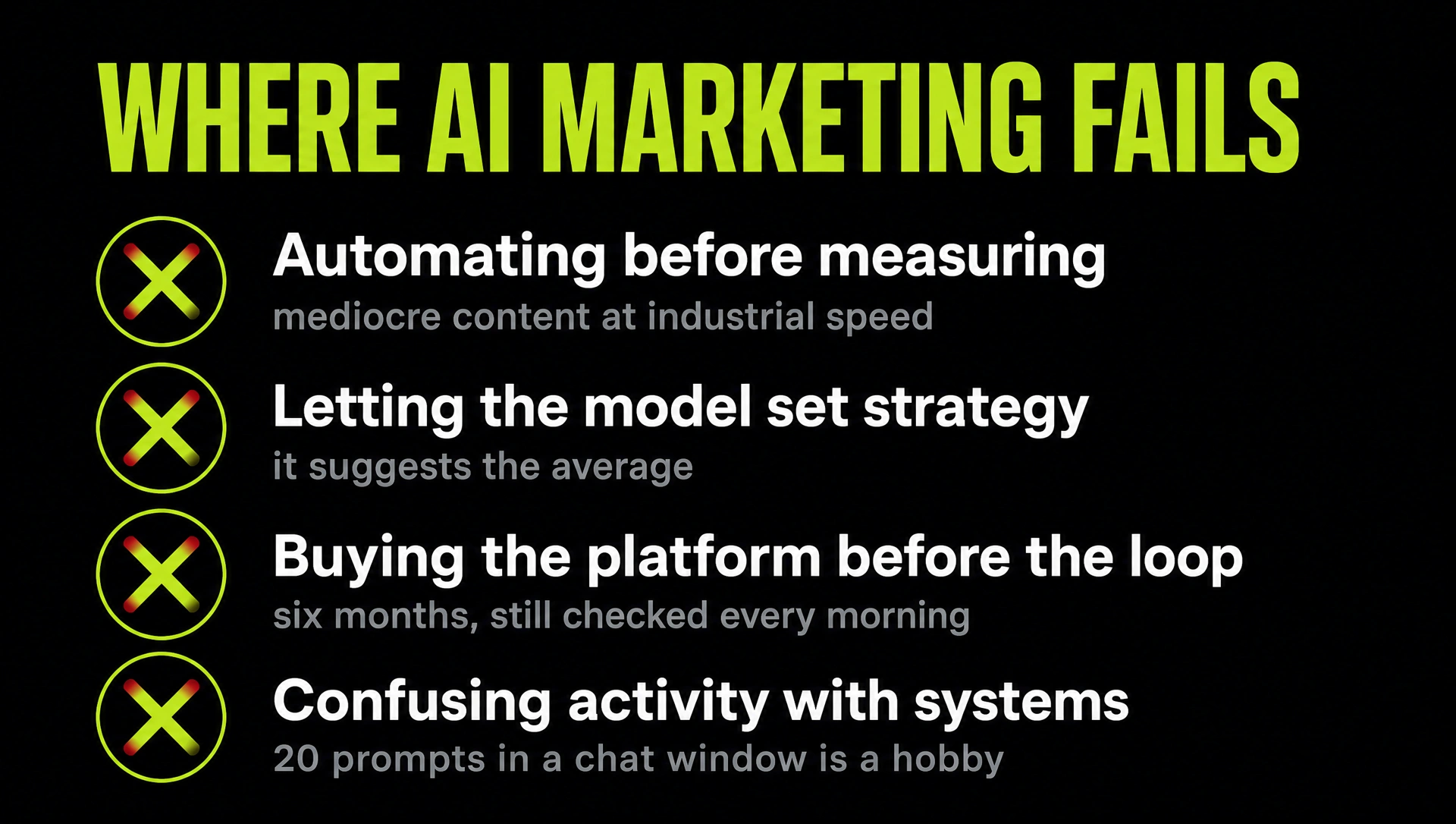
Every quarter a new platform promises to orchestrate your entire marketing funnel with AI. One dashboard. Full automation. Zero manual work.
Every quarter, the implementation takes six months, the integrations break, and someone still has to check it every morning.
Complex buyers need human judgment in the loop. Especially in B2B. Especially in markets like Switzerland where relationships and precision matter more than automation speed.
Buy tools that solve specific problems well. Be deeply suspicious of tools that claim to solve everything.
What the Winning Teams Actually Look Like
I’ve watched marketing teams succeed and fail with AI over the last two years. The winners share a few traits.
They started small and specific. One use case. One tool. Measurable outcome. Then they expanded.
They treated AI as a team member, not a magic box. The tools needed onboarding, iteration, and someone responsible for output quality.
They killed tools that didn’t perform. No sunk-cost attachment. If the ROI wasn’t there after a real test, they moved on. Fast.
They invested in data before they invested in AI. Clean CRM. Proper UTM tracking. Unified customer data. Without this foundation, every AI tool underperforms.

Building Your AI Marketing Strategy for 2026
Here’s the practical framework I’d give any marketing leader starting today.
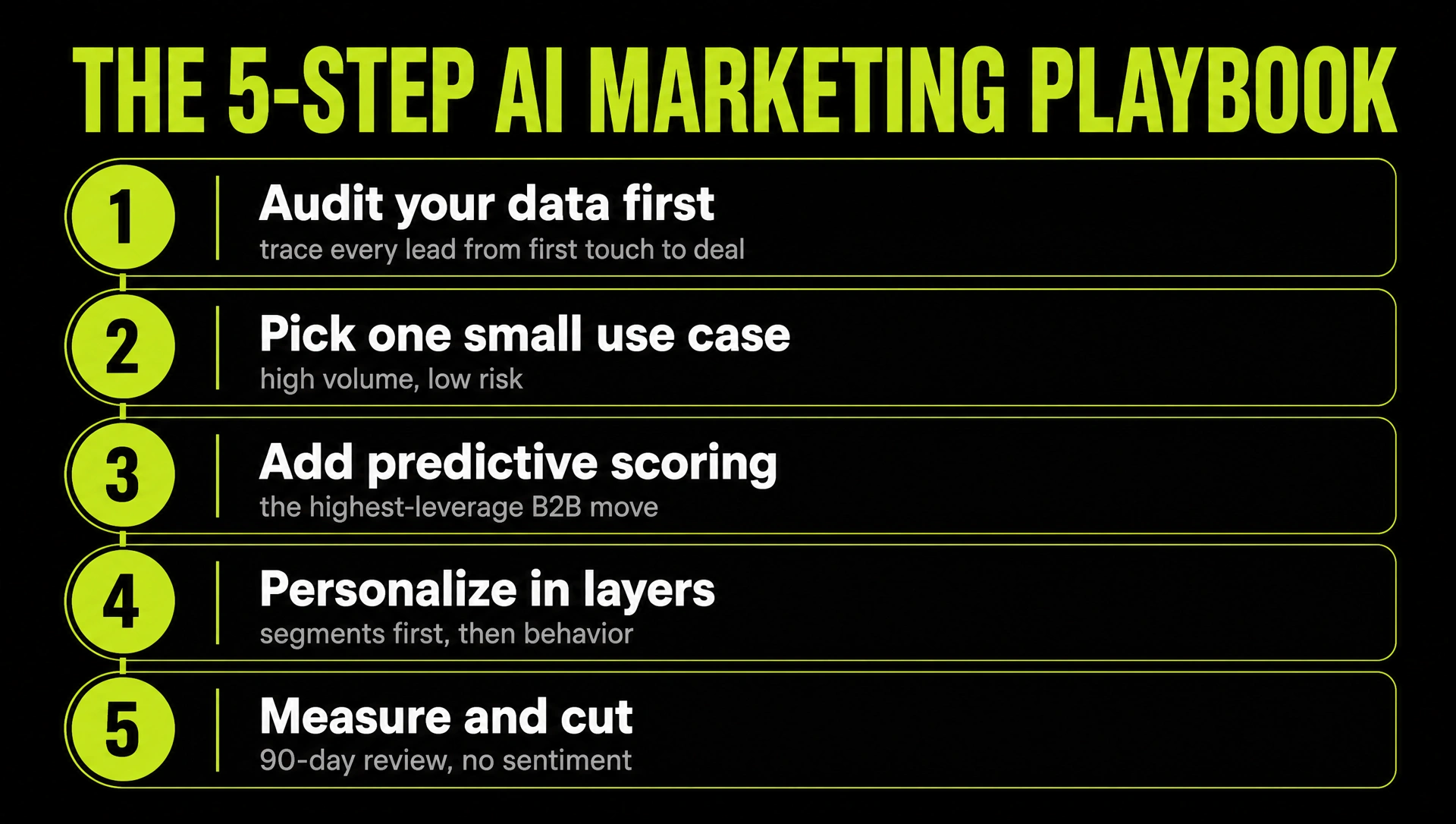
Step 1: Audit your data foundation. Can you clearly trace a lead from first touch to closed deal? If not, fix that before anything else.
Step 2: Pick one high-volume, low-risk use case. Email subject line testing or ad copy variants are good starting points. Low downside if the AI underperforms.
Step 3: Add predictive scoring to your lead process. If you’re in B2B, this is the highest-leverage move available to you right now.
Step 4: Build personalization in layers. Start with segment-level personalization. Expand to behavioral triggers. One layer at a time.
Step 5: Measure ruthlessly and cut what doesn’t work. Set a 90-day review cadence for every AI tool in your stack. Make the ROI case explicit. Cut the tools that don’t pay for themselves.
The Uncomfortable Truth About AI Marketing in 2026
After testing more tools than I care to admit, one pattern holds.
AI amplifies what’s already there. If your strategy is weak, AI makes you fail faster and at scale. If your strategy is strong, AI compounds your results. There is no shortcut here.

The marketers panicking about AI taking their jobs are often the same ones who never built strong strategic judgment in the first place. AI cannot replace that. It never will.
The marketers thriving right now are the ones who treated AI as a force multiplier for good thinking. Not a replacement for thinking.
Your AI marketing strategy for 2026 is only as good as the strategic mind behind it. Invest in that first.
Frequently Asked Questions
What is the highest-ROI AI marketing application for B2B companies in 2026?
Predictive lead scoring. Reported improvements in sales qualified lead rates run 30 to 50 percent, with vendor-claimed figures at the top of that range. The prerequisite is clean CRM data. Get that right and the ROI is hard to argue with.
How do I know if an AI marketing tool is real or just hype?
Ask the vendor for a case study with a named customer, a specific metric, and a defined time period. If they can’t produce that, you’re looking at a product that hasn’t proven itself yet. Also ask: what does the tool do that a well-configured non-AI tool cannot? If the answer is vague, keep walking.
How much should a mid-size B2B marketing team budget for AI tools in 2026?
There is no universal number. If you want a starting hypothesis, 5 to 10 percent of your total martech spend for AI-specific tools and experimentation is defensible. More important than budget size is budget discipline. Small experiments with clear success metrics beat large commitments to untested platforms every time.
My Final Take
That’s the whole playbook. It’s less glamorous than the conference keynotes suggest. It’s also far more effective.
If you want to talk through what an honest, results-focused AI marketing strategy looks like for your business, get in touch with me directly. No buzzwords. No magic. Just what works.

Oleksandr Moccogni
Head of Marketing at SSI Schäfer Switzerland and Founder of Moccogni Consulting. I write from 15+ years spent running growth for global brands, where data, AI and marketing actually meet.